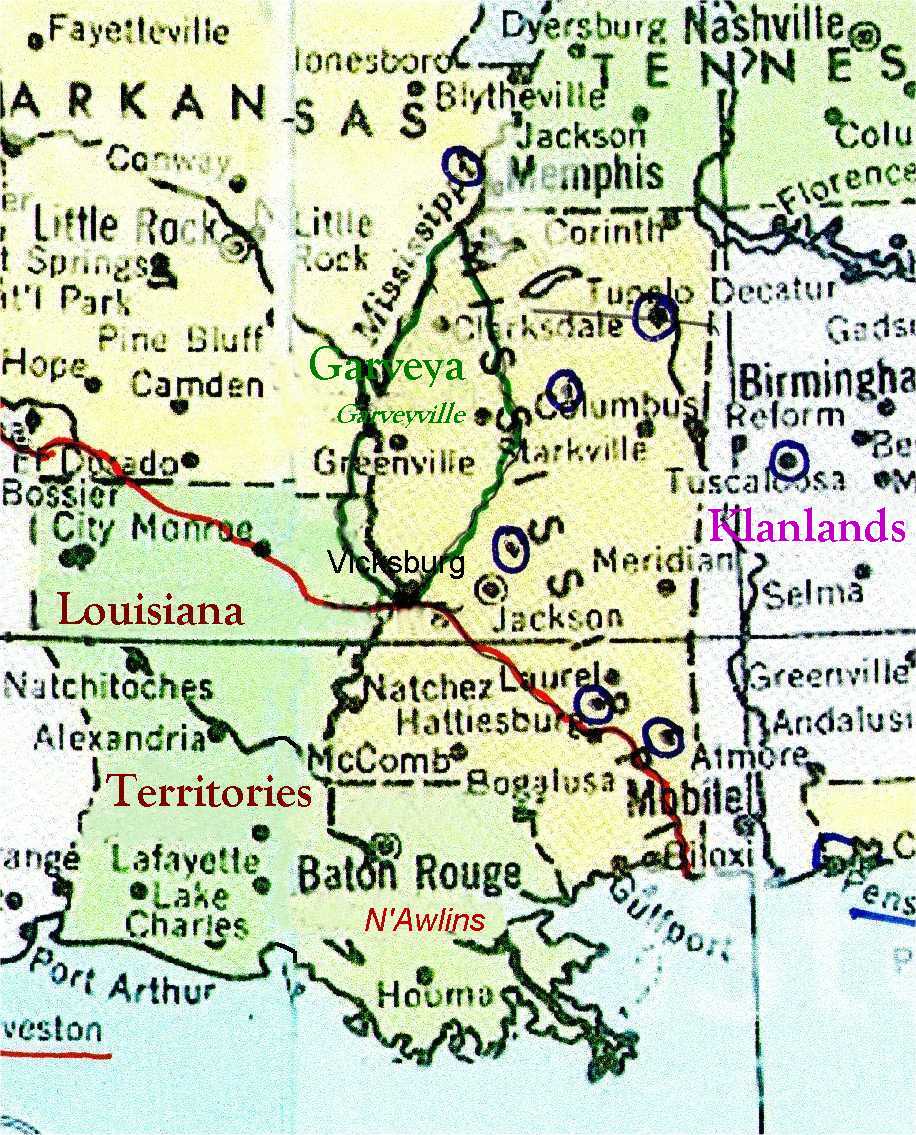
The Davis-Knights are a wealthy family from Beaumont in eastern Texas where they made their money from oil. Family influence spread over in to nearby Louisiana, it was only natural that they would lead the eastward expansion of the Texican Republic. Patrice, the second son, was allowed a freehand in assimilating the old lands to the east. While much of Texas was still being reclaimed he was mainly ignored and given no direct Texican support in his efforts. With little real force at hand he used his political skills and cuts deals and brokered treaties right across old Louisiana. His real stroke of genius was to offer citizenship of the Louisiana Territories to virtually all residents including those of black or a mixed ethnic heritage. In one stroke a wide swathe of support was gained. He also negotiated the secret treaty with Black Separatist state of Garveya and supplies them with economic and military support while with the other hand offering scared white communities protection under his rule.
Patrice was greatly aided by his co-operation with Frederick Morsell a prominent black landowner and major figure in N’Awlins. They formed an unlikely private friendship with Morsell becoming the de facto Mayor of N’Awlins and in turn giving full support to his Texan friend. He also used his family wealth to fund the re-openinig of the old refinery at Lake Charles in west Louisiana and the reclamation of the long abandoned oil wells.
By 96 A.F. Overseer-General Patrice Davis-Knight controls 90% of the old state of Louisiana, including the city of N’Awlins, plus a good 25% of old Mississippi. He controls a quarter of Texican lands and rivals the President-General in his power and wealth. Only a direct order halted the advance eastward a mere 10 miles from the Alabama border and 100 miles from the ARC base at Pensacola. He has been ordered to consolidate the lands under his jurisdiction and has enthusiastically begun to do so with the expansion of salvage operations. The Louisiana Territories are blessed with excellent farming land, a treasure trove of potential salvage, petroleum and other natural resources. The Philip Charles refinery has brought a steady stream of petrolium to the territory bringing jobs, prosperity and a strategic resource for Patrice's further plans. Patrice could easily form his own country but he makes it clear he is a loyal son of Texas while being a kind paternal provincial governor.
N’Awlins
Under the guidance of Frederick Morsell the city has flourished as an international free port where all manner of goods are traded by all manner of people. ARC traders rub shoulders with Red Cubans while Klan merchants sell to Mexican buyers securely. It is said if you can pay enough then you can find pretty much anything in N’Awlins. There is a wide range of entertainment in the city from music halls, cinemas, fine restaurants down to low costs bars and bordellos. The city is also very racially mixed and has an easy going attitude.
Patrice Davis-Knight has left N’Awlins alone save for its formal absorption in to the Louisiana Territories and for a modest tax payment. Recently he has even started selling petroleum from the Placid Refinery through N’Awlins to raise funds for the re-building of the territory; this has greatly increased his independence from the Texican Treasury. The NOC, N’Awlins Oil Company, sells to anyone with the cash with no questions asked; its major client is in fact the ARC. It is a major source of revenue for Patrice Davis-Knight and his plans.
 Natchez and Old Mississippi
A major anchor point of Texican expansion is the city of Natchez and Adams County. For years Natchez had very much a live and let live attitude and refused to engage in unprofitable race wars and religious intolerance. Trade and commerce was the heart of Natchez and it made for a wealthy and profitable city. Though never expansionist it did lead the creation of the Riverine Force and the Natchez Fencibles to protect the Mississippi from pirates and the city from brigands.
In the last decade tension grew as Klanlands to the east fanned the flames of racism but with little real adoption by the populace. Trade with Garveya, N’awlins and now the Texican Republic has proved far too profitable till last year Natchez and Adams County formally joined the Louisiana Territories. Texican troops were stationed in the city which became a forward operating base for the Republic and boosted investment in to the area.
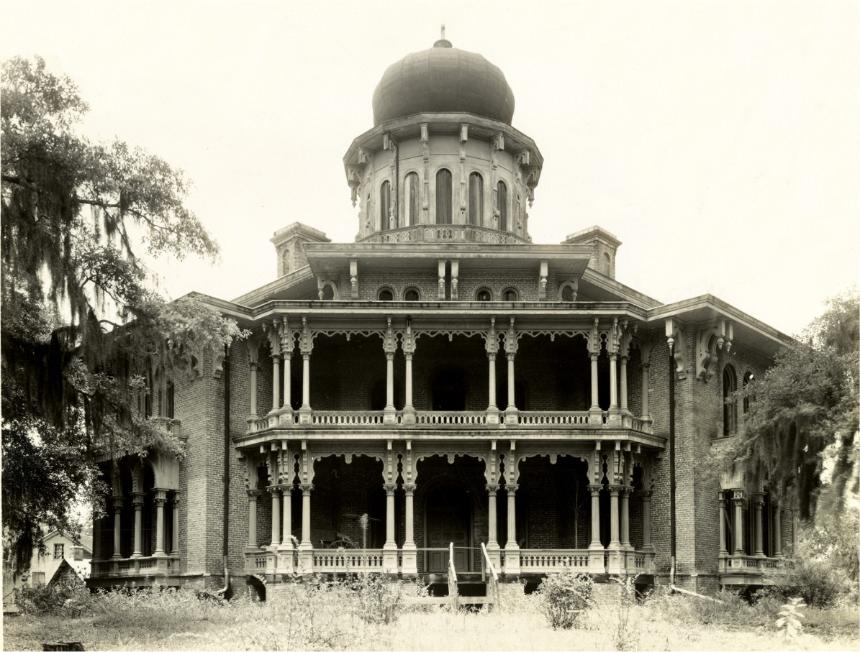
The old Longwood Mansion was renovated and became the official Texican residency for Natchez and Adams County and the unofficial base of operations for the whole of the northern border. The local airport, Hardy–Anders Field, was repaired and made operational with a flight of Texican Grasshopper reconnaissance planes stationed there. To show willingness the Natchez Fencibles became the Mississippi Infantry and a volunteer force, the 3rd Regiment, was enlisted in Texican service.
Natchez has a diverse population of citizens with a majority of mixed-ethnicity and white backgrounds. The Texicans have acted accordingly generally keeping out of local matters and only interfering with the lightest of touches. Though nominally an Orthodox Baptist city its mixed populace also has places of worship to the Nation of Islam, Branch Davidian, Peoples Temple of the Disciples of Christ and other smaller faiths.
© Copyright Winwick Pig Publishing 2022